
If you are starting exercise, choose an activity you can manage now and a time that fits your day. This guide helps adults plan everyday movement. It does not prescribe exercise for a medical condition or pain.
1. Make the first plan small and specific
Instead of ‘I should exercise more,’ write down a time and place: a short walk near work after lunch, for example. Choosing five or ten minutes can help you get started. It is not an exercise target for everyone or a promise of a particular result.
Make a brief note of whether the time and setting worked for you. Use that note to plan your next session. Choose an activity you enjoy and that matches your abilities. CDC: Adding physical activity as an adult
2. Use adult activity guidelines as something to work toward
CDC’s general adult guidance calls for at least 150 minutes of moderate-intensity aerobic activity a week, 75 minutes of vigorous activity, or an equivalent combination. It also includes muscle-strengthening activity for the major muscle groups on at least two days a week. Aerobic activity can be spread across the week in shorter periods. CDC: Adult activity overview
You do not have to meet those figures on your first day. Start with how active you are now and what your health allows.
CDC distinguishes adults aged 18–64 from those 65 and older, whose guidance also includes balance activity. If you are pregnant, have recently given birth, have a disability, or have a chronic condition, use the guidance for your circumstances and consider your individual needs. CDC: guidance for different groups
3. The same walk can feel different to different people
A simple guide to moderate effort is being able to hold a conversation while finding singing difficult. At vigorous effort, you need to pause for breath after only a few words. This is an approximate check: the same pace can feel different depending on fitness and health. CDC: Measuring activity intensity
A leisurely walk does not have to count as moderate exercise to belong in your activity notes. Recording light and moderate activity separately gives you a clearer picture of your week.
4. Include muscle-strengthening activity too
Walking is one way to begin aerobic activity. Muscle-strengthening options include resistance bands, weights, and exercises that use your body weight. Suitable movements and resistance depend on your current abilities. Learn how to perform unfamiliar movements, and make increases in intensity gradually. CDC: Examples of aerobic and strength activities
5. Have an option for busy days
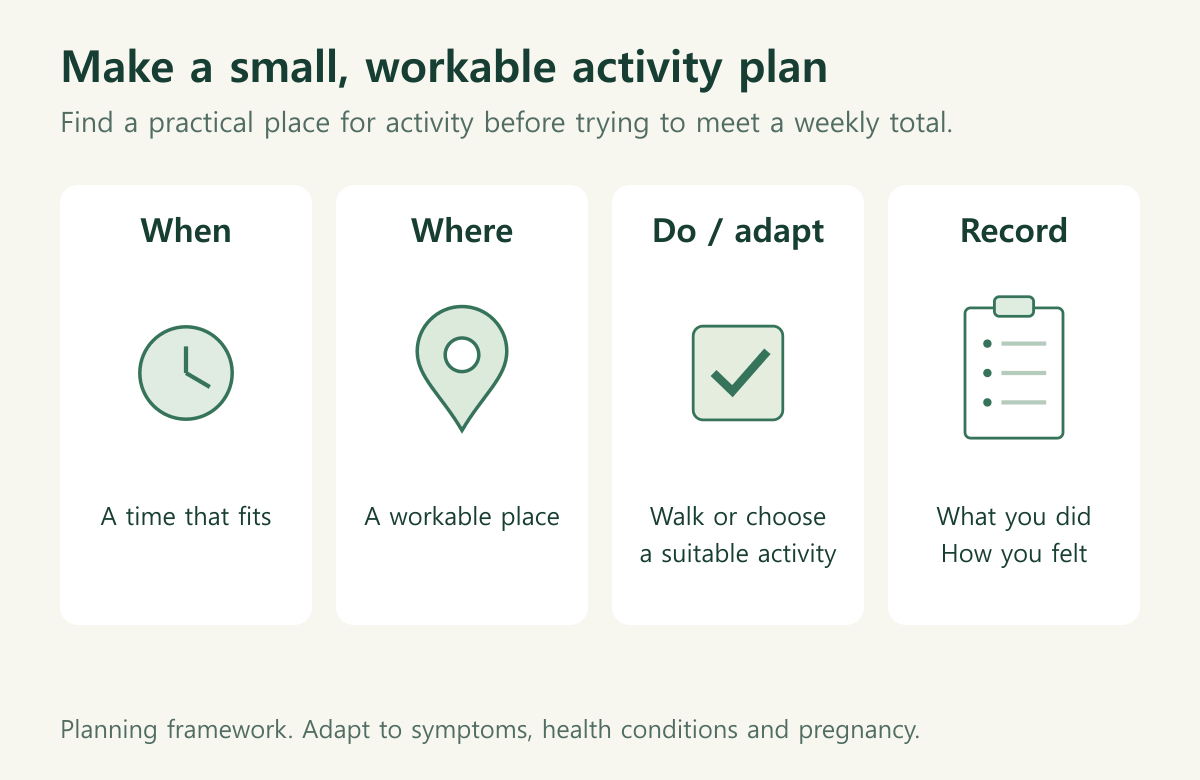
If you cannot fit in a longer session, look for a shorter opening in your day or a chance to walk part of a journey. If the weather or route is unsuitable, consider an indoor option. Write down these three details to make the plan concrete.
- When: connect it to something you already do, such as finishing lunch.
- Where and what: choose a setting and an activity, such as a short walk near work.
- An alternative: if it rains, for example, set aside time to move indoors.
‘After ______, I will try ______ at ______. If that does not work that day, I will ______ instead.’
Use this example to choose a time and place. It is not a personal exercise prescription or a full routine that meets weekly recommendations.
Separate the plan from what actually happened
| What to plan or record | Example to adapt |
|---|---|
| A reminder to begin | After finishing lunch |
| Place and accessible activity | An indoor space or nearby route you can use |
| What actually happened | Afterwards, note what you did, for how long, and how hard it felt |
| What got in the way | Choose one change to timing, weather plans, or access |
This table helps with planning; it is not a full weekly schedule that meets activity targets. Note what you did and how hard it felt before classifying its intensity. On days when you sit for long periods, look for movement you can manage. If standing or walking is difficult, choose an activity suited to your abilities.
When personal guidance matters
Discuss suitable activity types and amounts with your clinician if you have a chronic condition. Check before starting vigorous exercise after inactivity or with a disability. Needing advice does not automatically mean you must avoid all light movement. CDC: when to seek advice
Do not push through new chest pain to finish a planned activity. Sudden persistent chest pain, pain that spreads, or chest pain with sweating, dizziness, or breathlessness needs immediate emergency help. NHS: chest pain
Return to Movement & Activity · Explore Food & Nutrition · Explore Wellness & Recovery
- CDC — Adult Activity: An Overview: adult aerobic and strength recommendations and splitting activity into shorter periods.
- CDC — How to Measure Physical Activity Intensity: the talk test and differences in relative effort.
- CDC — What Counts as Physical Activity for Adults: activity examples and adjusting intensity.
- CDC — Adding Physical Activity as an Adult: choosing activities and when to consult a healthcare professional.
Sources checked: September 8, 2026. We created the everyday planning examples to help explain the guidance. See our Editorial Policy for sourcing and review practices.