When choosing a resistance band, start with the exercise you want to do and how far the band was stretched when its resistance was measured. A “beginner” colour or a number in kilograms or pounds is not enough to compare two products.
Before buying a set, check which type of band your exercise uses and make sure you understand the instructions. This guide helps you read labels and compare products. It does not provide a personal training or rehabilitation programme.
Check how far the band was stretched for its resistance rating
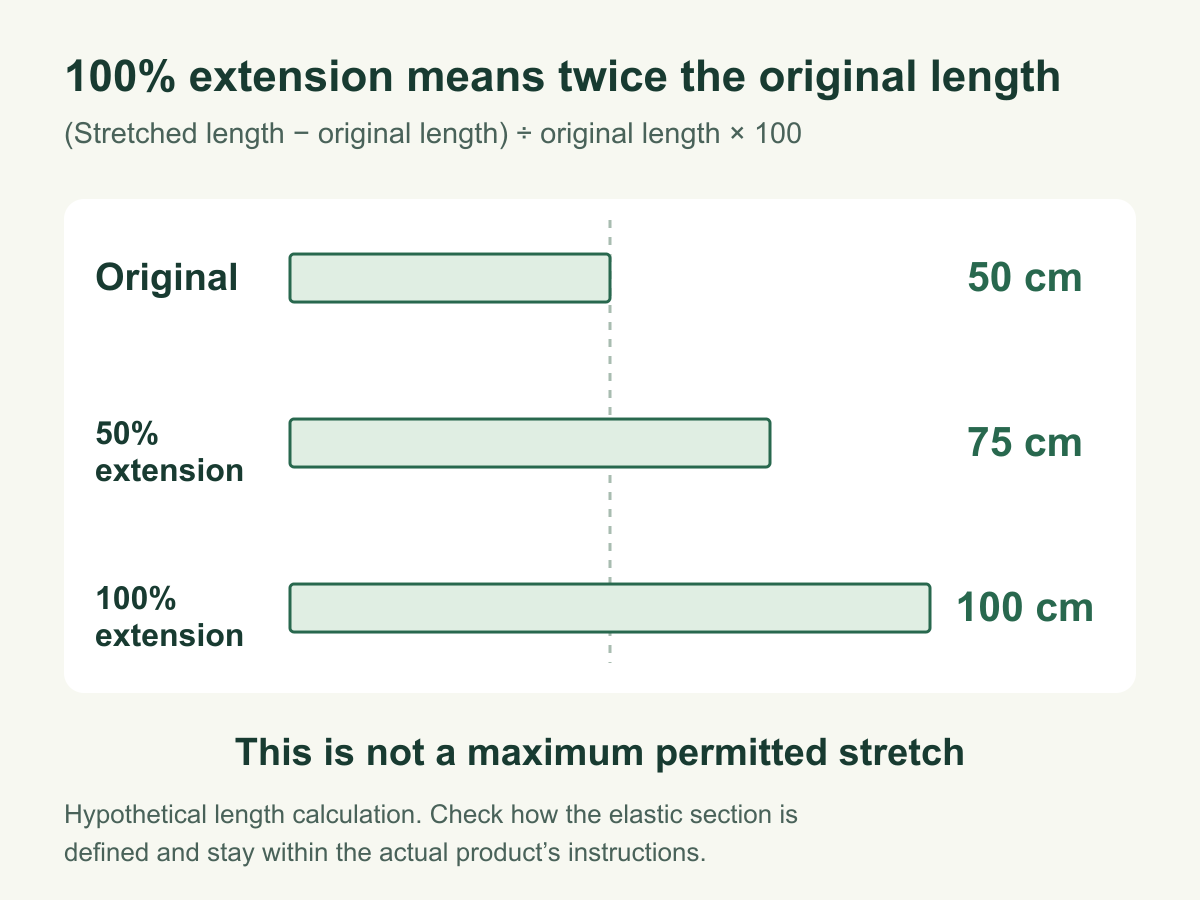
Performance Health describes the resistance of its THERABAND tubing in relation to elongation: how much longer the band becomes when stretched. Stretching it to twice its original length is 100% elongation. You need that detail to make sense of the resistance rating. Manufacturer’s tubing information
Do not read a band labelled “5 kg” as though it were a fixed 5 kg dumbbell. Check how far it was stretched, which exact version was measured, and how the measurement was taken. If the listing gives a minimum–maximum range, does it explain what each end means? Without those details, you cannot reliably compare the number with another product.
Colour codes also depend on the manufacturer and product series. Do not assume that identically coloured bands from different brands represent the same resistance.
Calculate elongation using the original elastic length
Divide the increase in length by the original length:
Elongation (%) = (stretched length − original length) ÷ original length × 100
These are fictional arithmetic examples, not safe stretching limits:
| Original elastic length | Stretched length | Calculation | Elongation |
|---|---|---|---|
| 50 cm | 75 cm | (75 − 50) ÷ 50 × 100 | 50% |
| 50 cm | 100 cm | (100 − 50) ÷ 50 × 100 | 100% |
| 80 cm | 120 cm | (120 − 80) ÷ 80 × 100 | 50% |
The first and third rows add different numbers of centimetres but have the same percentage increase. In the second row, 100% elongation means adding the original length, so the final length is double the starting length. It does not mean leaving the band at its original length. This interpretation is also explained in the manufacturer’s THERABAND kit guidance.
Check whether the product’s quoted starting length refers to the elastic part or includes handles and other components. If you do not know what was measured, you cannot reliably compare the lengths. Do not overstretch a band to investigate its rating.
Match the type of band to the exercise
Flat strips, closed loops and tubes with handles are different types of band. Even with similar resistance ratings, they may not be interchangeable for the exercise you want to do.
| Product form | What to confirm | An assumption to avoid |
|---|---|---|
| Long flat strip | The required length and grip for the movement you have learned | Using an unspecified length without instructions for holding it |
| Closed loop | Loop size and the body position or exercise it is intended for | Treating short and long loops as interchangeable |
| Tube with handles | Compatibility of the tube, handles and other attachments | Assembling unrelated components because they connect |
Write down one intended movement and check it against the instructions or the guidance you received. If a professional has prescribed rehabilitation exercises, do not substitute a different band or resistance without their advice. The THERABAND kit guidance itself advises consulting a suitable healthcare or fitness professional about resistance selection. Manufacturer’s kit guidance
Age and gender alone are not enough to choose a resistance in kilograms. You may need different bands for different movements. Check what your exercise requires before deciding whether an inexpensive multipack will be useful.
Details to write down when comparing products
| Detail | What to write down |
|---|---|
| Exact product | Brand, product family and selected option |
| Form | Flat strip, loop or handled tube |
| Intended use | Movement already learned and any individual restrictions |
| Resistance claim | Figure, unit and stated elongation or test condition |
| Length | Starting length and which components it includes |
| Material | Stated material and any latex warning |
| Safety instructions | Maximum permitted stretch, approved anchors, protective equipment and care |
| Package contents | Included handles, connectors and anchors, with compatibility information |
If you have a latex allergy and do not know the band’s material, do not use it until you can confirm that it is suitable for you. The cited THERABAND tubing page carries a latex warning for that product; this does not mean that every resistance band contains latex. Manufacturer’s material warning
Know when to stop before trying more resistance
Inspect for tears, worn areas, cracks and damaged connections before use. The THERABAND kit instructions advise replacing damaged bands and wearing protective eyewear. Ordinary glasses should not be assumed to provide the specified protection. Manufacturer’s inspection and eye-protection guidance
The same stretching limit does not apply to every band. Follow the exact product’s limit and anchoring method. If an anchor setup is unclear, do not improvise with a door handle or furniture. Do not pull harder on a band you think may be damaged to see whether it will break.
Stop exercising if you feel pain or become unwell; seek advice if your concerns continue. This is the general exercise-video safety advice included on the NHS page, not an endorsement of band exercise for foot pain. NHS: exercise-video safety information
If a band you already own has known specifications, is in good condition and suits the movement you have learned, you may not need a new set just for more colours. First decide what your current band cannot provide.
For general activity planning, read Getting Started With Exercise: Walking and Everyday Movement.
Sources checked: 8 September 2026. AI helped with research, drafting and adapting our Korean article into English. Manufacturer documents support the definitions and product-specific warnings; UK NHS guidance supports the general advice on when to stop exercising. The calculations are original examples. We have not tested resistance, durability or breaking strength.