How much salt is 600 mg of sodium?
600 mg of sodium equals 1.5 g of salt equivalent using the EU factor of 2.5, or 1.524 g using Japan’s factor of 2.54. Use the convention for the food label. This is a conversion of sodium, not a measurement of salt added during manufacture.
Check the label basis first: if 600 mg is listed per 100 g and you eat 30 g, your portion contains 180 mg of sodium—not 600 mg. Use the calculator below for a different amount.
Choose the nutrient and unit shown on the pack, then enter the label basis and the amount you will eat. Select the conversion convention for the label, regardless of this page’s language. The shared link contains your numeric inputs and calculation settings. Anyone who receives it can see those settings.
Sodium, salt and portion calculator
Calculate the amount in the portion you will eat
This calculator converts sodium in milligrams to salt equivalent in grams, or the other way around. It also adjusts a per-100-g label to the amount you will eat. EU salt labelling uses a factor of 2.5; the Japanese salt-equivalent convention uses 2.54. Choose the convention for the label, regardless of this page’s language. The existing examples using 2.5 below follow the EU convention or give an approximate comparison.
Formulas: sodium (mg) × factor ÷ 1,000 = salt equivalent (g). In reverse: salt equivalent (g) × 1,000 ÷ factor = sodium (mg). For 400 mg of sodium, the results are 1 g with factor 2.5 and 1.016 g with factor 2.54.
Fictional label example: a food contains 600 mg of sodium per 100 g and you eat 30 g. That gives 600 × 30 ÷ 100 = 180 mg of sodium, equivalent to 0.45 g of salt under the EU convention or 0.4572 g under the Japanese convention. Choosing ‘Per labelled portion’ calculates one complete portion on the label; the grams field does not apply in that mode. It does not calculate multiple portions or part of that portion.
The result converts the label value; it does not reveal how much salt the manufacturer added. Sodium may come from other ingredients, and label values can be rounded or subject to tolerances. Do not turn a value such as ‘less than 0.1 g’, or a range, into an exact number. Save the inputs and results as CSV or share a link containing the numeric settings. Anyone receiving the link can see those settings. This tool does not set a personal daily intake target.
Conversion conventions and examples checked: 9 October 2026. Sources: European Commission: dietary salt, sodium and EU labelling; Japan’s MEXT: salt equivalent.
Compare two labels: equal quantity and your portions
Enter each label value, its reference quantity and the amount you plan to eat. The comparison stops if one uses g and the other mL, or if their sold/prepared states differ. For salt declarations, select the conversion convention for each label.
Formula: declared sodium × planned portion ÷ reference quantity. For salt in g, first multiply by 1,000 and divide by the convention factor to obtain sodium in mg. The formula and worked example remain usable without JavaScript.
Hypothetical check: A declares 600 mg sodium/100 g and you plan 30 g. B declares 0.3 g salt/30 g (EU 2.5) and you plan 60 g. Per 100 g: A 600 mg, B 400 mg. In your portions: A 180 mg, B 240 mg. B contributes 60 mg more.
This calculation does not send inputs to the server or save them in the URL. A downloaded CSV contains your inputs and calculated values.
Compare equal volumes, then the amount you plan to use
The US manufacturer’s online nutrition tables list 960mg sodium per 15mL for the regular product and 590mg per 15mL for the 5 fl oz Less Sodium product. At equal volume, the latter contains less declared sodium.
For an assumed 5mL of the regular product: 960 × 5 ÷ 15 = 320mg. An assumed 15mL of Less Sodium provides 590mg. In this example, the larger portion of the less concentrated product gives 270mg more sodium.
These amounts illustrate arithmetic, not recommended intake. This is a calculation from official web labels, not a laboratory test, taste test or health ranking. Check the package, market and amount actually eaten.
2026-10-22 · Kikkoman USA · Soy Sauce (Non-GMO), 10 FL OZ · Kikkoman USA · Less Sodium, 5 FL OZ

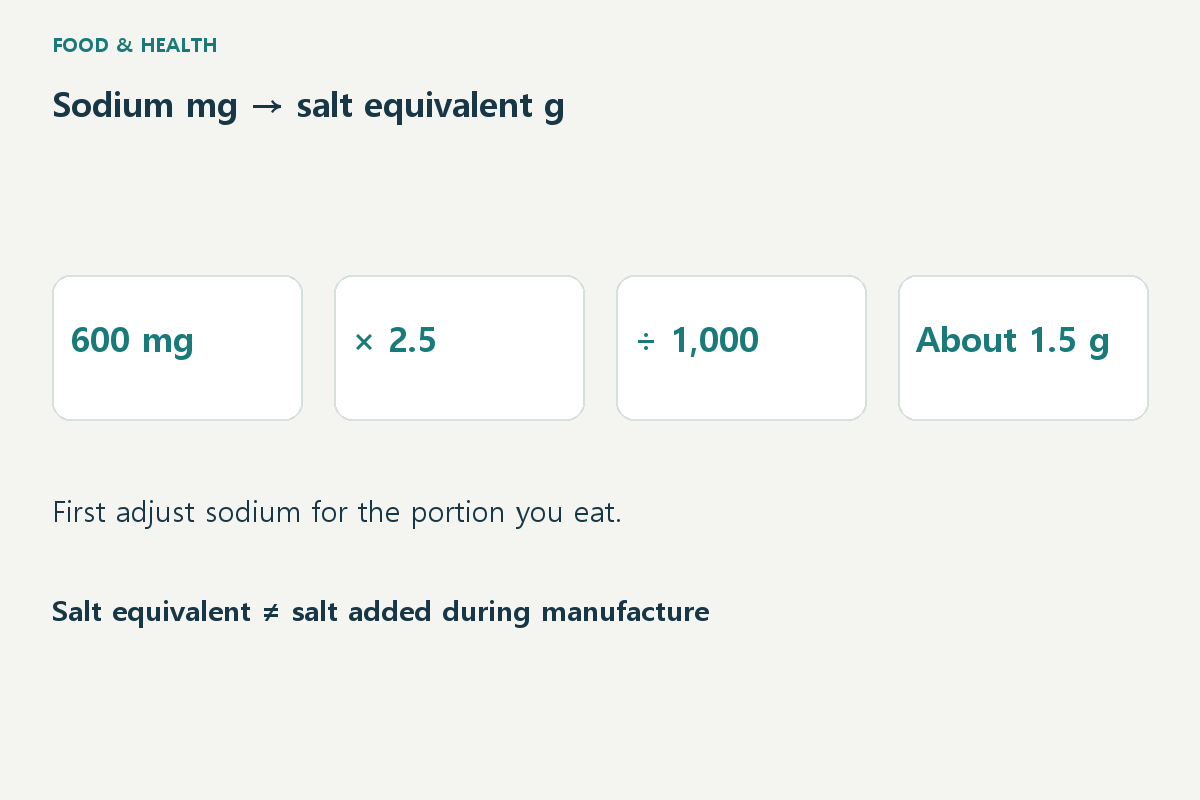
First identify the nutrient and the unit
Korea’s Food Safety Korea explains that 1 g of salt contains approximately 400 mg of sodium. That relationship gives the approximate conversion factor of 2.5. Food Safety Korea sodium guidance
A label saying “sodium 600 mg” and another saying “salt 1.5 g” may describe equivalent amounts. Comparing 600 with 1.5 without checking the names and units makes the difference look enormous when it is not.
Do the calculation in two stages
- Calculate sodium for the portion actually eaten. Multiply a per-serving figure by the number of servings.
- Multiply that sodium total by 2.5, then divide by 1,000 to express the salt equivalent in grams.
| Sodium | Salt: EU × 2.5 | Salt: Japan × 2.54 |
|---|---|---|
| 200 mg | 0.5 g | 0.508 g |
| 400 mg | 1 g | 1.016 g |
| 600 mg | 1.5 g | 1.524 g |
| 1000 mg | 2.5 g | 2.54 g |
Calculated values, not laboratory measurements. Food labels may be rounded. Choose the convention for the label, not the language you are reading. Table checked 15 October 2026. Conversion sources: EU 1169/2011, Annex I · MEXT.
To go the other way using the EU factor of 2.5, use salt in g × 400 = sodium in mg. Thus 1.5 g of salt corresponds to about 600 mg of sodium. These are approximate label-comparison conversions, not laboratory measurements.
What if the packet contains two servings?
Consider an invented soup packet containing two servings, with 450 mg sodium per serving. Eating the whole packet gives 900 mg sodium, equivalent to 2.25 g salt. Half the packet gives 450 mg sodium, equivalent to about 1.13 g salt. Write both lines so the portion adjustment is visible:
Actual sodium: 450 mg × 2 servings = 900 mg
Salt equivalent: 900 × 2.5 ÷ 1,000 = 2.25 g
Keep the amount of powder used separate from the amount of prepared soup eaten. Adding more water does not remove sodium from the whole batch. On the other hand, leaving broth behind does not let you calculate an exact reduction from the label alone. Sodium may not be distributed evenly between broth and solid ingredients, so “half the broth left means exactly half the sodium” is too precise.
Three things the result cannot tell you
- Added salt by weight: sodium can come from ingredients other than salt.
- An exact teaspoon measure: salt texture and how a spoon is filled affect volume. Keep the result in grams.
- Your personal daily limit: converting a unit is different from setting a dietary treatment target.
A quick routine for comparing two products
Match the amount of food first: per 100 g, or the same intended meal portion. Convert both labels to sodium or both to salt. Then calculate what you will actually eat. Also check whether the panel describes dry powder or the food after preparation; if that is unclear, ask the manufacturer rather than filling the gap with an assumption.
If you have been given a sodium or fluid limit for a medical condition, use the target and recording units your clinician provided. This calculation helps interpret a label; it does not establish a treatment plan.
Related guide
How to Read Serving and Package Sizes on Korean Nutrition Labels
Sources checked: 20 September 2026. Prepared and reviewed with AI assistance using official information. This is an informational guide, not a first-hand product test or site visit.
Calculate labelled sodium or salt for your portion
More tools from Durudam
Compare carts before buying more for free shipping →
Use the two actual checkout screens to see whether delivery savings reduce the final payment. Share numeric inputs or keep the comparison as CSV.
Drying laundry: windows and electricity →
Plan airing and dehumidifying separately. Use session kWh or watts and hours to record electricity use and estimated usage cost.
Recorded energy and rated-power assumptions kept distinctCompare palace visit dates →
Compare 1–7 days of regular closures and save an official-check checklist.