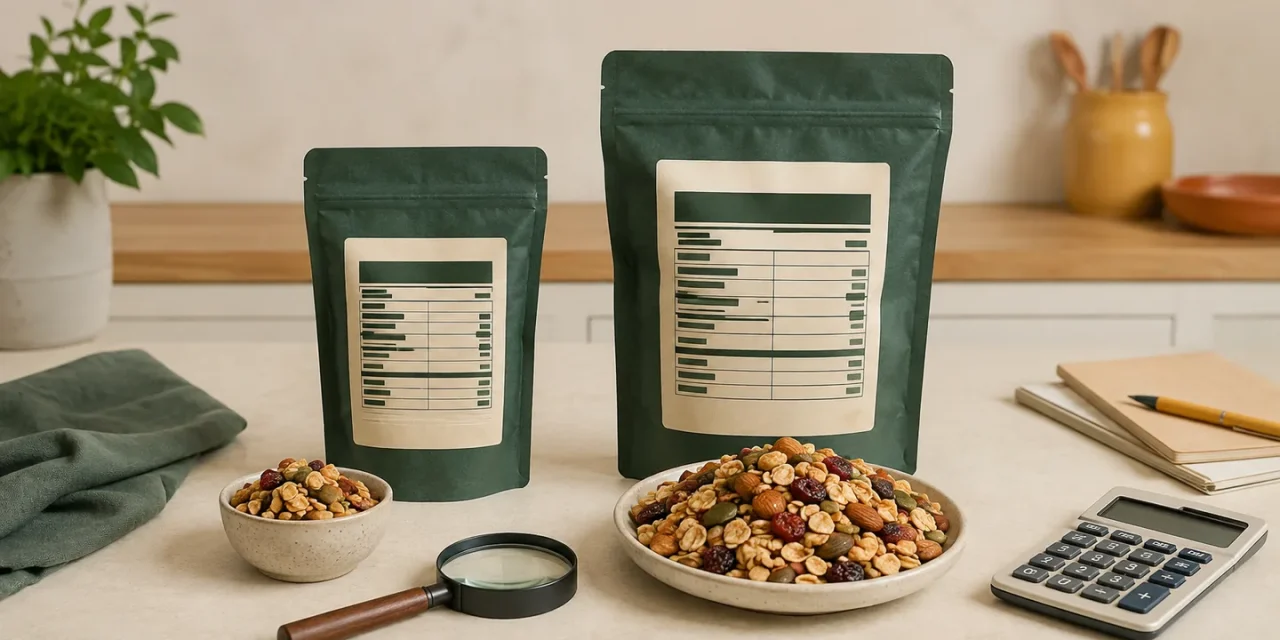
Two similar products can be hard to compare when one nutrition label lists the full package and the other lists values per 100 g. The lower calorie number may simply refer to a smaller amount of food.
Keep three different amounts separate
Total package quantity is the total weight or volume of food in the package. The label reference amount is the amount of food the nutrition figures describe. It may be the entire package, one unit, 100 g, or 100 mL. Amount actually eaten is how much you eat that time.
When all three amounts are the same, the calculation is simple. If a package contains 50 g, the label is based on the full 50 g, and you eat all of it, the listed values match what you ate. If a 200 g package lists values per 100 g and you eat the whole package, each listed value must be doubled.
A published MFDS interpretation explains that labeling units can depend on packaging and quantity. It is based on 2023 rules. It helps explain why you should check the amount stated on the label, but it does not confirm whether a label meets current law. MFDS interpretation of labeling units
A label’s serving amount is not a personal portion recommendation
Korea’s food-labeling standards use a reference amount based on how much people typically eat at one time to help determine how nutrition information is shown. This does not mean you must eat that exact amount regardless of your age, body size, activity, or health.
Common misconception: When a package says “one serving,” it is easy to assume that the whole package is meant to be eaten at once. Some packages contain several small units or are intended to be eaten over several occasions, so check the total quantity and number of units as well.
How to scale the label to the amount you ate
You need only one formula:
Use matching units for the amount eaten and the reference amount. The numbers below are made-up examples, not results from food testing. Adjusting a label value gives an estimate, not a guarantee of the exact nutrients in what you ate.
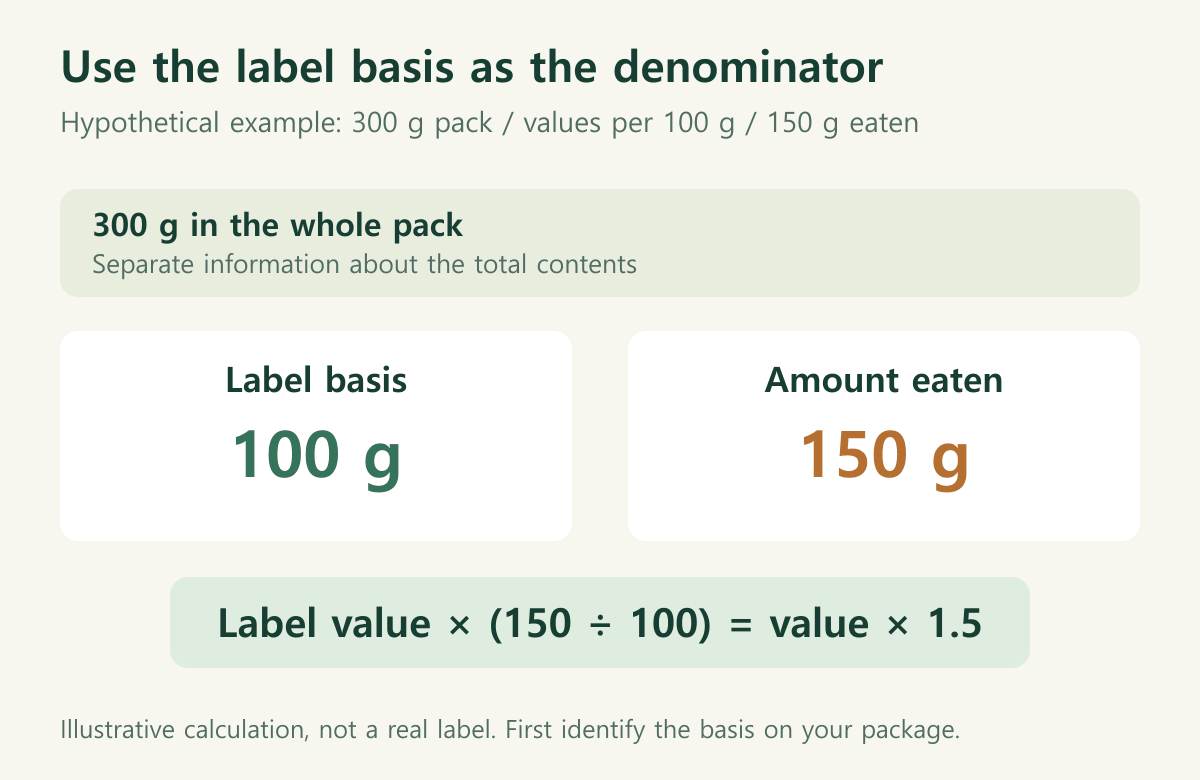
For a 300 g package labeled per 100 g, eating 150 g gives a multiplier of 150 ÷ 100 = 1.5. Use the label reference amount in the division, rather than the 300 g package total.
Example 1: Eating 60 g of a product labeled per 100 g
If the label lists 300 mg sodium per 100 g, calculate 300 × 60 ÷ 100. The label-based estimate for a 60 g portion is 180 mg.
Example 2: Eating half of the full package
If the label lists 480 kcal for the entire package and you eat exactly half, the amount is 240 kcal. If you estimated half by eye, remember that the result is also an estimate.
Example 3: Eating two individual pieces
If the nutrition information is listed for one piece, multiply every nutrient by two when you eat two pieces. Do not double calories while forgetting sodium, saturated fat, or the other listed nutrients.
Take an extra moment with powders mixed with water or milk, drained canned foods, or mixtures in which the ingredients are unevenly distributed. Read whether the label describes the food as sold or prepared, and whether liquid is included. Calculating from weight alone may not accurately describe what you ate. Ask the manufacturer if the basis is unclear.
How to compare two products fairly
- Convert both products to the same basis. Per 100 g or the amount you realistically expect to eat is often convenient.
- Choose the nutrients you want to compare, rather than looking only at calories.
- Separate nutrients you may want to limit, such as sodium or sugars (당류), from nutrients that may help you plan the meal, such as protein or fiber.
- Read the ingredient list and allergen statement too. A nutrition panel alone cannot determine whether a product is appropriate for you.
If one product is labeled per 30 g and another per 40 g, do not place the numbers side by side without adjustment. Converting both to 100 g—or to the 35 g portion you plan to eat—makes the difference clearer.
What does % Daily Value mean?
% Daily Value shows how much a serving contributes to a general daily reference amount. It does not calculate your exact personal needs. Read it alongside the rest of your meal and what you eat across the day. If you must adjust intake for a medical condition, do not build a treatment plan from general label interpretation alone.
A 10-second label check at the store
Move through the label in this order: total package quantity → label reference amount → amount you expect to eat → nutrient you want to compare. You do not need to memorize many numbers. Checking that both labels describe the same amount helps you avoid comparing mismatched figures.
A nutrition label does not make a food simply good or bad. It helps you see how the product might fit with the rest of what you eat. For a more realistic view, consider it alongside the other foods in a meal, as shown in How to Build a Balanced Weeknight Plate.
Korea Law Information Center / Ministry of Food and Drug Safety — Interpreting nutrition-label reference units
National Institute of Food and Drug Safety Evaluation — Reference amounts per eating occasion, with product examples
Labeling standards can change. For a Korea-specific legal interpretation, consult the latest Ministry of Food and Drug Safety notices.