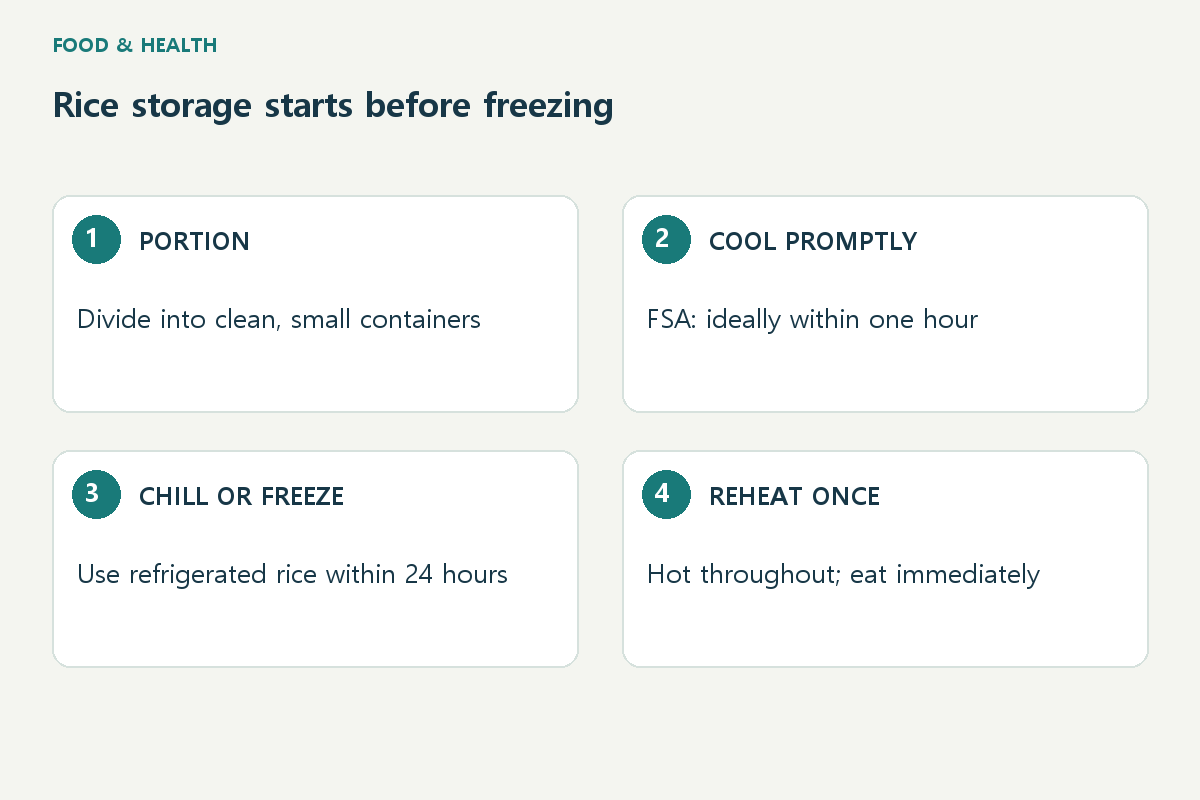
Good freezer-rice habits start before the rice reaches the freezer. Divide leftovers into small portions, cool them promptly and reheat the portion you will eat until it is hot throughout. Freezing is not a way to rescue rice that has already been poorly stored.

Why the cooling stage matters
The UK Food Standards Agency explains that Bacillus cereus spores may survive cooking and bacteria can grow and produce toxins in rice left at room temperature. This guide uses the FSA’s conservative household advice for rice. FSA home food fact checker
Separate dinner from tomorrow’s portions
- Decide what you are saving and prepare clean, small containers before leftovers sit around.
- Divide the rice rather than putting a large amount into one deep container.
- Cool promptly, ideally within one hour; use refrigerated rice within 24 hours under the FSA guidance.
- For later meals, cool quickly, freeze in small portions and label the date.
These are the FSA’s rice-specific recommendations, not one universal storage rule for every food or jurisdiction. Do not reset the clock by freezing rice after it has been left out for an unknown period. FSA rice storage guidance
A practical three-portion example
Imagine cooking enough for three meals. Eat one portion now and divide the other two into separate containers. If you will definitely eat one within the next 24 hours, cool it promptly and refrigerate it. Cool and freeze the portion intended for later. The useful decision happens now, not when the rice has spent the afternoon on the table.
Label each portion with when it was cooked, when it was frozen and how much it contains. A readable date is more useful than an elaborate container system. If you intend to microwave it, check that the container is suitable and follow its lid or venting instructions. Portioning also avoids warming a large batch just to serve one person.
Check the centre, not just the timer
For frozen rice, the FSA advises defrosting in the fridge, reheating until steaming hot throughout and eating immediately. Rice should only be reheated once. FSA rice reheating advice
Microwaves can leave cold spots. Stirring and following the appliance or food instructions for standing time help address uneven heating. A fixed “three minutes” cannot guarantee the result for every portion, container and microwave. FSA cooking and reheating guidance
| What you notice | What to do next |
|---|---|
| Hot edges, cold centre | Stir, continue heating and check again |
| Leftovers after reheating | Do not plan repeated freeze-and-reheat cycles |
| Unknown time at room temperature | Do not use smell alone to declare it safe |
| Takeaway rice | Check the supplier’s advice; it may already have been reheated |
The freezer does not erase the earlier handling
Before choosing a portion, check its label and take only what you need. A freezer date tells you when it was stored, not whether it was cooled properly beforehand. This guide deliberately avoids a single “safe for X months” promise for every freezer and container. If you do not know how the rice was handled, tasting it is not a suitable safety test.
For the next batch, make the routine easy: containers ready, portions divided, prompt cooling, clear labels and one portion reheated at a time. Those are actions you can control without trying to judge safety from the texture of a reheated bowl.
Related guide
How to Thaw Frozen Food Safely
Sources checked: 20 September 2026. Prepared and reviewed with AI assistance using official information. This is an informational guide, not a first-hand product test or site visit.