Eight hours between getting into bed and getting up does not necessarily mean eight hours asleep. A useful sleep diary records those times separately, alongside the naps, drinks and daytime sleepiness that belong to that night.
You can do this with paper or a phone note. The aim is to make your experience easier to discuss, not to diagnose a sleep disorder or design your own treatment.
Divide entries between morning and evening
The US National Heart, Lung, and Blood Institute (NHLBI) diary separates morning sleep notes from daytime-habit entries completed before bed. NHLBI sleep diary, PDF
Choose one way to date your entries and stick with it. An entry completed on the morning of 9 September can describe the night of 8–9 September. Keep the daytime events from 8 September with that night rather than accidentally attaching them to the following one.
In the morning, estimate the times as best you remember them. You do not need to keep checking the clock all night to make the diary look exact. It is fine to write “cannot remember.”
A worksheet you can copy into a note
We adapted the tables below for everyday note-taking. They have not been validated as a clinical scoring tool.
| Morning entry | What to write |
|---|---|
| Night covered and type of day | Dates; workday, day off or shift pattern |
| Into bed and trying to sleep | Time you began trying; note an earlier bedtime separately |
| Time taken to fall asleep | Your estimate in minutes |
| Waking during the night | Number of awakenings and estimated total time awake |
| Final waking time | When you woke and did not return to sleep |
| Getting-out-of-bed time | Keep this separate from final waking |
| How you felt on waking | Describe it in your own words |
| Medication or unusual events | What and when; do not alter medication for this diary |
For daytime notes, describing what happened can say more than a score alone. These entries are fictional, not recommended amounts or schedules:
| Daytime item | Example entry |
|---|---|
| Caffeinated drinks | Coffee at 09:00, one cup; tea at 15:30, one cup; add product and volume if known |
| Alcohol | Time, type and amount, or “none” |
| Nap | 13:20–13:40, about 20 minutes |
| Activity | Walk at 18:00, about 15 minutes |
| Daytime sleepiness | Struggled to concentrate in a meeting at 14:00 |
| Other circumstances | Overtime, travel or unusual noise |
“I struggled to follow the meeting” describes an effect on daily life that “7 out of 10” alone does not explain. You may record both if that helps you stay consistent.
Calculate estimated sleep without counting an awake period twice
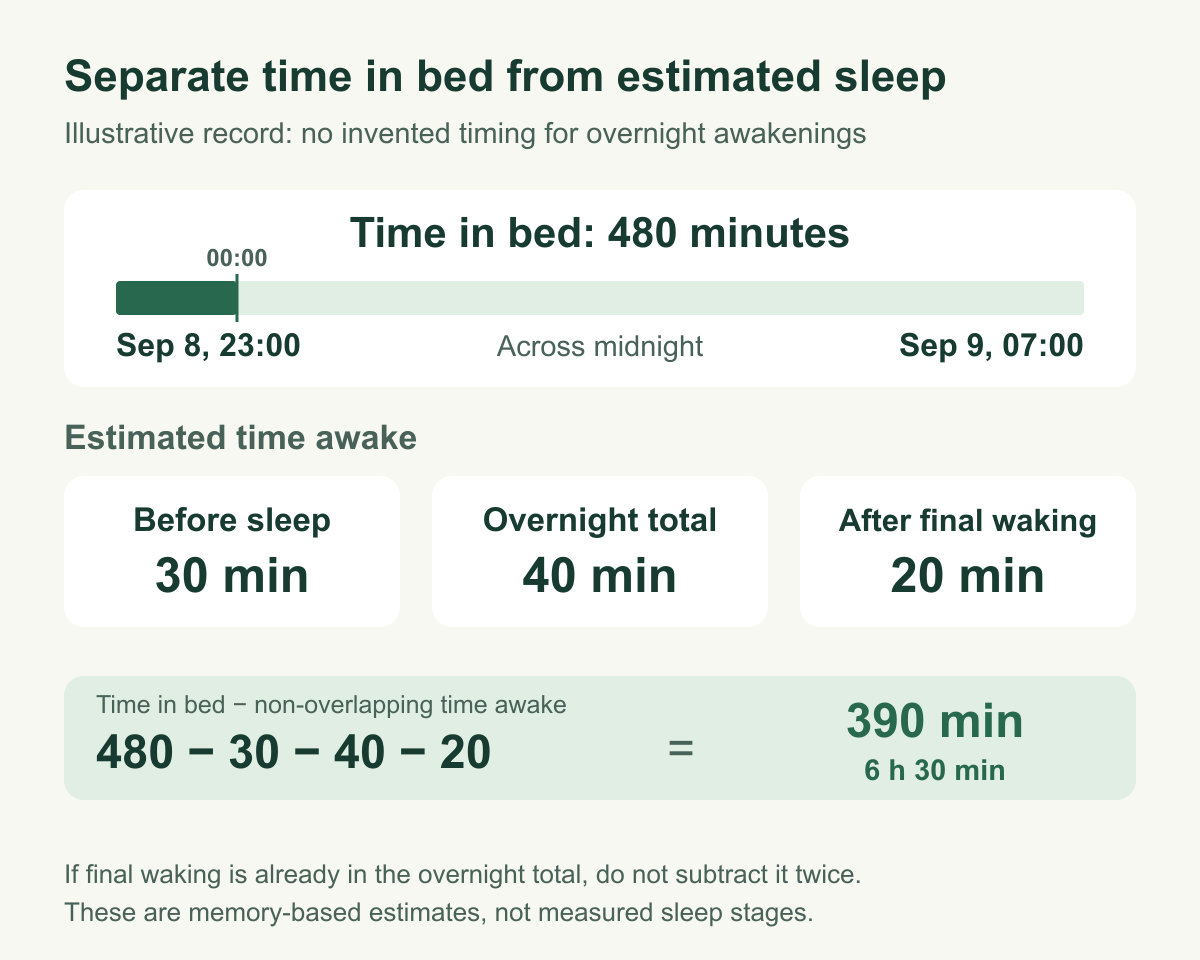
Consider this fictional night:
- Into bed and trying to sleep: 23:00.
- Out of bed: 07:00 the following morning.
- Estimated time to fall asleep: 30 minutes.
- Total awake during the night: 40 minutes.
- Awake after the final awakening, before getting up: 20 minutes.
Time in bed is eight hours, or 480 minutes. In this example, the three awake periods are separate:
480 − 30 − 40 − 20 = 390 minutes, or 6 hours 30 minutes of estimated sleep.
This result is an arithmetic example, not a recommended sleep duration. If the final 20 minutes were already included in the 40-minute total, subtracting them again would undercount sleep. Check what each field means on whichever form you use.
Your estimate from memory cannot tell you how much deep sleep or REM sleep you had, or show on its own how well you slept.
Look for patterns across several nights
Read several entries together before drawing conclusions. These questions can help you prepare for a conversation about your sleep:
| Comparison | What to look at | What this cannot tell you on its own |
|---|---|---|
| Workdays and days off | Bedtime, waking time and daytime difficulty | That weekend sleep explains all tiredness |
| Days with later caffeine | Time, drink type, amount and other circumstances | That one drink caused one poor night |
| Shorter and longer sleep estimates | How you functioned the following day | That a longer estimate rules out a problem |
If overtime, a late coffee and a later bedtime occur together, a diary does not separate their effects. Note that they happened together without assuming which one caused the poor sleep.
NHLBI suggests that a diary kept for one to two weeks before a medical visit can help explain sleep difficulties. The diary can help you prepare for a visit, but you should not postpone care to finish it. NHLBI: discussing sleep problems
Check your recording routine before buying a device
Paper, an existing notes app or a spreadsheet may already do everything you need. Try a format that makes yesterday’s entry easy to find and the daily routine easy to keep. Use dates consistently.
If you already use a wearable, keep its estimates in one column and your own notes in another. Do not erase one to make it match the other. Note the device or app name and mention any relevant differences at your appointment. This guide does not compare wearable accuracy or show that a device can diagnose a sleep disorder.
Use the diary to support a conversation about symptoms
Talk with a clinician when sleep problems affect daily activities. Mention loud snoring, waking gasping or breathless, and repeated daytime sleepiness; health conditions and medicines may also need review. NHLBI: clinical assessment
Start with when the problem began, which days it happens and what has become difficult during the day. Do not use a diary score to increase or decrease sleep medication, or drastically cut your time in bed on your own.
For a separate guide to planning everyday activity, see Getting Started With Exercise: Walking and Everyday Movement.
Sources checked: 8 September 2026. AI helped with research, drafting and adapting our Korean article into English. The worksheet and arithmetic example are original editorial material informed by US NHLBI guidance, not a validated clinical assessment or treatment programme.