Creatine can support strength training and repeated, brief bursts of intense exercise. Creatine monohydrate is the most extensively studied form. Healthy-adult studies commonly use 3–5 g daily; an initial high-dose “loading” phase is optional. When taking a product, follow its labeled daily amount and precautions. NIH guide to exercise supplements
This guide separates well-supported benefits from questions the research has yet to settle. The dose comparisons describe general approaches studied in healthy adults. They are not instructions for people with kidney disease, those taking relevant medicines, people who are pregnant or breastfeeding, or adolescents. Sources were checked on September 10, 2026.
How creatine helps muscles regenerate ATP
Muscles use ATP when they contract. Releasing energy converts ATP to ADP; intense effort requires rapid ATP replacement. Stored phosphocreatine donates a phosphate group to ADP, regenerating ATP. During recovery, ATP produced by other metabolic processes helps replenish phosphocreatine. ISSN explanation of creatine metabolism
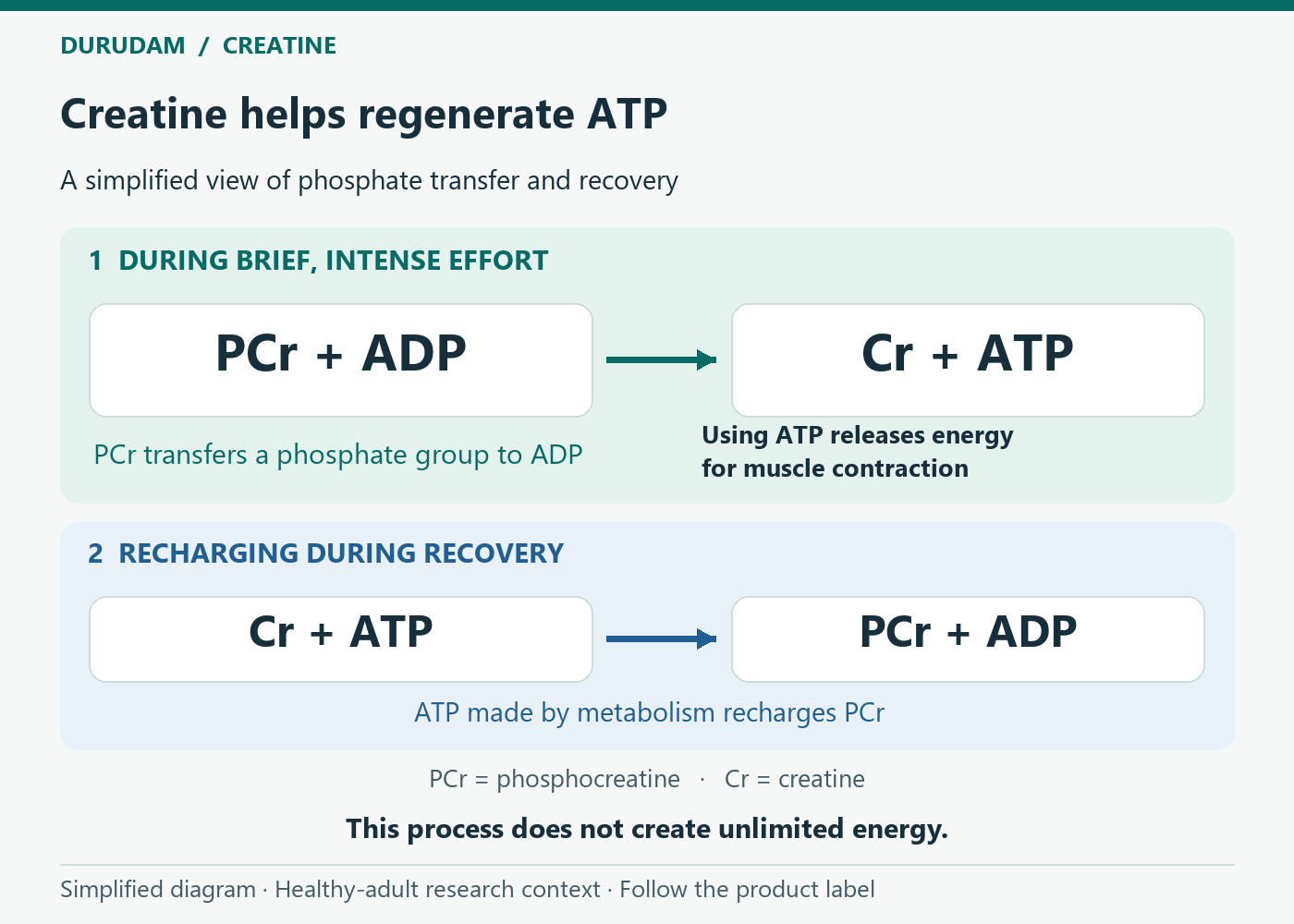
Thinking of creatine as a coffee-like ingredient that makes you feel alert immediately can set the wrong expectation. Its purpose here is to increase muscle stores that support repeated intense efforts. “Helps regenerate ATP” does not mean unlimited energy or an ability to keep exercising without fatigue.
Which benefits does the evidence support?
Strength and some measures of power are the clearest expectations
A 2025 meta-analysis of 69 randomized trials found average improvements in bench or chest press, squats and some power measures, but not every outcome. Training methods and participants varied, so the results cannot promise how many extra kilograms an individual will lift. 2025 strength and power meta-analysis
Set a goal such as supporting the strength-training plan you intend to follow, rather than expecting a supplement to replace that plan. Whether you mainly want a faster distance-running time or better repeated efforts in weight training also changes the case for buying it.
Weight gain does not necessarily mean new muscle
Early weight gain can partly reflect more water in muscle. A higher scale reading is not all new muscle tissue. Benefits for purely endurance exercise are limited, and extra weight can be a disadvantage in some sports. NIH discussion of exercise type and body weight
Memory and concentration are not established reasons to buy it
Cognitive research continues, but the two primary cognitive outcomes in a 2023 trial with 123 participants were not statistically significant by conventional standards. EFSA’s 2024 assessment also found that a causal relationship with improved cognition in healthy adults had not been established. An effect worth investigating is not an effect already confirmed. Randomized cognitive-performance trial; EFSA assessment
Creatine dosage: distinguish the daily total from each serving
These are common research approaches for healthy adults, not a required nutrient intake or a permitted dose for every product. For example, if a Korean product you import specifies 3 g per day, the rapid-loading schedule below is not permission to exceed that label.
Read the dose table as amounts of the creatine monohydrate ingredient in a supplement. The later food table measures creatine itself in food; its gram amounts are not exact equivalents of the supplement amounts.
On a small screen, swipe the table sideways to see every column.
| Approach | Daily total | Individual dose | Duration and next step |
|---|---|---|---|
| Slow loading Start with a smaller daily amount |
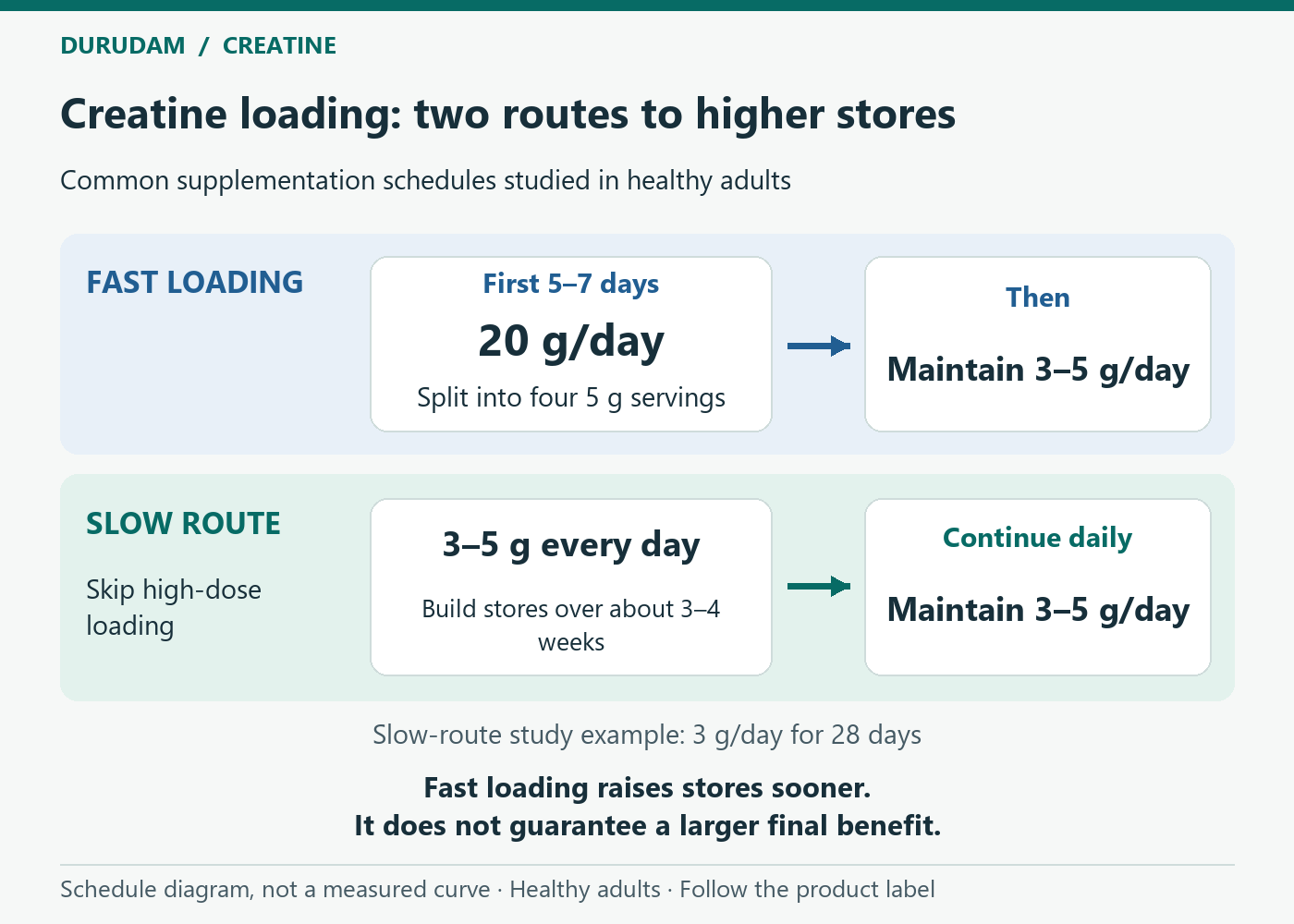
3–5 g | 3–5 g if taken once daily | Build stores over about 3–4 weeks, then continue the same daily amount |
| Rapid loading Build stores more quickly |
20 g | 5 g, 4 times daily | For 5–7 days, then switch to maintenance |
| Maintenance after rapid loading | 3–5 g | 3–5 g if taken once daily | Continue, including on rest days |
The rapid-loading and maintenance ranges come from the NIH guidance. A study of 31 men found similar increases in muscle creatine stores with 3 g daily for 28 days and 20 g daily for six days. That comparison concerns storage, not a guarantee of identical exercise results for everyone. Hultman and colleagues’ muscle-storage study
Should you choose slow or rapid loading?
If you are starting without a deadline, a smaller daily amount can be simpler to manage. You do not have to organize several doses each day, and you avoid taking a large amount at once, which can upset your stomach. “Slow loading” is not a special product: it means starting at a maintenance-level daily amount.
Rapid loading is an option to consider when reaching higher stores sooner matters, but it does not promise a greater final benefit. The 20 g figure is a whole-day total, not a single dose. Do not choose it if it conflicts with the product’s directions or your health circumstances. Increasing the amount or extending the loading phase on your own is not a shortcut to recommend.
Reading an imported Korean label: grams matter more than scoops
One product listed in Korea’s Food Safety Korea database specifies a daily 3.1 g of powder containing 3 g of creatine monohydrate, measured as approximately three of its scoops. Powder weight, ingredient quantity and scoop count are different information. Another product’s scoop is not interchangeable. This Korean-label example illustrates how to read an imported product; it is not a recommendation of that product. Food Safety Korea product-label example
Build a routine you can follow before worrying about exact timing
- Connect it to something you already do. Within the product’s directions, a regular point in your day, such as after breakfast, can make the dose easier to remember. Evidence does not clearly establish that taking creatine immediately after exercise is superior to other times. Review of supplementation timing
- Keep a record of your training, too. Note the load, repetitions and training dates for the same exercises. That gives you something more useful to consider than weight changes alone. Avoid deciding that supplementation has succeeded or failed solely from how the first week feels.
- Check meals and sleep first. Frequently skipping meals or leaving little time for recovery makes it difficult for a supplement alone to complete your plan. Taking creatine is not a reason to neglect food or make an aggressive increase in training.
- Match hydration to your activity and conditions. You do not need to invent a universal rule to drink a particular number of extra liters every day. Consider fluid replacement on sweaty training days alongside the product’s precautions.
- Do not take a missed day’s amount all at once. Returning to the product’s usual daily amount at the next dose is a simpler way to avoid mistakes. Use your record to prevent duplicate doses, not as a reason to keep raising the amount.
More is not automatically better, and there is no need to add large amounts of sugar in pursuit of absorption. An increase in uptake under study conditions does not necessarily translate into better training results. Review of dose and co-ingestion
Side effects and common safety concerns
Weight gain and digestive symptoms deserve attention
Alongside weight changes, stomach discomfort or diarrhea can occur. In a 28-day trial involving 59 male soccer players, diarrhea was reported more often with one 10 g dose than with two 5 g doses. This small study cannot predict everyone’s risk, but it illustrates why the amount taken at once matters. Stop taking it and consult a healthcare professional if symptoms persist. Study of individual dose size and digestive symptoms
A higher creatinine result does not automatically mean kidney damage
Creatine and the blood-test marker creatinine are different substances. A 2026 meta-analysis of 26 randomized trials found that creatinine could rise and creatinine-based estimated filtration could appear lower, without a significant difference in separately measured filtration. Tell your clinician about creatine use before testing. Do not dismiss an abnormal result as “just the supplement.” These findings do not establish safety in kidney disease. 2026 kidney-function meta-analysis
Has creatine been shown to cause hair loss?
A 2025 trial of 5 g daily for 12 weeks found no worsening of DHT or measured hair outcomes versus placebo in resistance-trained men. There were 38 completers; the study cannot settle effects in women or over years of use. It supports neither “hair loss is proven” nor “there can never be a connection for anyone.” 2025 randomized trial of hair outcomes
“It inevitably causes dehydration or cramps” also goes too far
In a randomized crossover trial of 12 active men, short-term creatine use did not worsen hydration or temperature regulation during exercise in heat; researchers also observed no increase in cramps or heat-illness symptoms. This small, short trial does not establish zero risk in every situation or prove dehydration prevention. Keep addressing hydration in hot weather and follow product precautions about fluids and caffeine. Watson and colleagues’ controlled heat-exercise trial
Speak with a healthcare professional first if you have kidney disease or take medicines that may affect your kidneys. If you are pregnant, breastfeeding or an adolescent, do not simply adopt the healthy-adult dose table: check the product’s restrictions and seek appropriate professional guidance. “Generally well tolerated” is not a safety guarantee for every person or every amount.
How much meat or fish would provide a comparable amount?
Meat and fish contain creatine. These approximate calculations use published food-content estimates and the edible portion’s weight before cooking. They are not daily meal recommendations. Amounts vary with species or variety, cut and storage; the same concentration cannot simply be applied to cooked food weights. AESAN assessment: food creatine content
On a small screen, swipe the table sideways to see every column.
| Food | Creatine per 100 g | Food providing 3 g | Food providing 5 g |
|---|---|---|---|
| Beef | About 0.45 g | About 670 g | About 1,110 g |
| Pork | About 0.50 g | About 600 g | About 1,000 g |
| Chicken | About 0.34 g | About 880 g | About 1,470 g |
| Salmon | About 0.45 g | About 670 g | About 1,110 g |
| Herring | About 0.65–1.00 g | About 300–460 g | About 500–770 g |
The calculation is target creatine amount ÷ creatine per 100 g of food × 100. For beef, 3 ÷ 0.45 × 100 ≈ 667 g, rounded here to about 670 g. The 3 g and 5 g targets help compare quantities; neither is a required dietary intake. Creatine in food is also different from the total weight of supplement powder. Creatine monohydrate includes water in its crystal structure, so check what the product’s stated grams actually measure.
You do not need to force yourself to eat large portions
Your body also makes creatine. Plant foods generally contain very little, but that does not make supplementation compulsory for vegetarians. A food’s value is not determined by its creatine content alone. AESAN discussion of dietary intake and synthesis
Do not undercook meat or fish to preserve creatine. Cooking losses vary by food and method; a retention figure from one cod experiment cannot be applied to chicken or every home-cooked meal. Use the table to understand scale, while planning actual meals around balanced nutrition and safe preparation. Study of changes during cod processing and cooking
Five checks before choosing a creatine product
- Is the form clearly identified? Single-ingredient creatine monohydrate is a useful starting point for comparison. A label such as “next generation” is not evidence that another form produces better exercise results. AESAN review of different forms
- Can you identify the daily amount and the creatine it contains? “5 g blend” tells you too little if the creatine quantity is missing. You cannot properly compare doses or value without it. Read the gram amounts before relying on the number of scoops.
- Can you verify the certification? Independent programs such as NSF check aspects of supplement quality, including label contents and contaminants. Sports certification also tests for banned substances. Look up the exact product in the certifier’s database rather than relying on a logo. Certification does not guarantee personal benefits or freedom from side effects. What NSF certification covers; Search certified products
- Are the seller, batch number and expiry date clear? Compare the listing with the ingredients, daily amount and batch details on the product you receive. If the listing and label disagree, ask the seller to resolve the discrepancy before deciding to use it.
- Are you comparing the cost of the amount you will actually take? Work out how many days the container provides at the labeled amount, rather than comparing container prices or prices per scoop. Product price ÷ days of use at the labeled amount gives you a more useful comparison between container sizes.
For a first purchase, write down four details for each candidate: the creatine form, actual creatine quantity, daily directions and verifiable quality information. If any are missing, an “X times better absorption” claim is not a substitute for the answer.
Common questions about taking creatine
Do I take it on rest days?
If you choose a daily approach to maintaining stores, include rest days in that plan. Follow the product’s directions consistently rather than raising or lowering the amount according to whether you trained that day.
Do I have to take a break every few months?
Evidence does not establish a compulsory cycle of breaks for healthy adults. A new condition, new medication or persistent discomfort is nevertheless a reason to reassess your existing plan. ISSN discussion of use and discontinuation
Can it replace a protein supplement?
The two serve different purposes. Buying creatine does not remove the need for protein in your diet. Start by distinguishing whether you want to address a dietary gap or support repeated high-intensity exercise.
How to read the evidence behind this guide
This article draws on government resources, scientific-society reviews, human trials and meta-analyses. Older food-content figures are used for approximate comparison, not presented as tests of a product you can buy. For the digestive-symptom and cod-cooking studies, we used only findings available in the public abstracts. Some creatine-paper authors disclose consulting or research relationships with the supplement industry; we have not turned a single paper’s conclusion into a product recommendation. Findings are not extended to populations or lengths of use for which evidence remains insufficient.
This is general educational information, not a substitute for an individual diagnosis, treatment or supplement prescription.